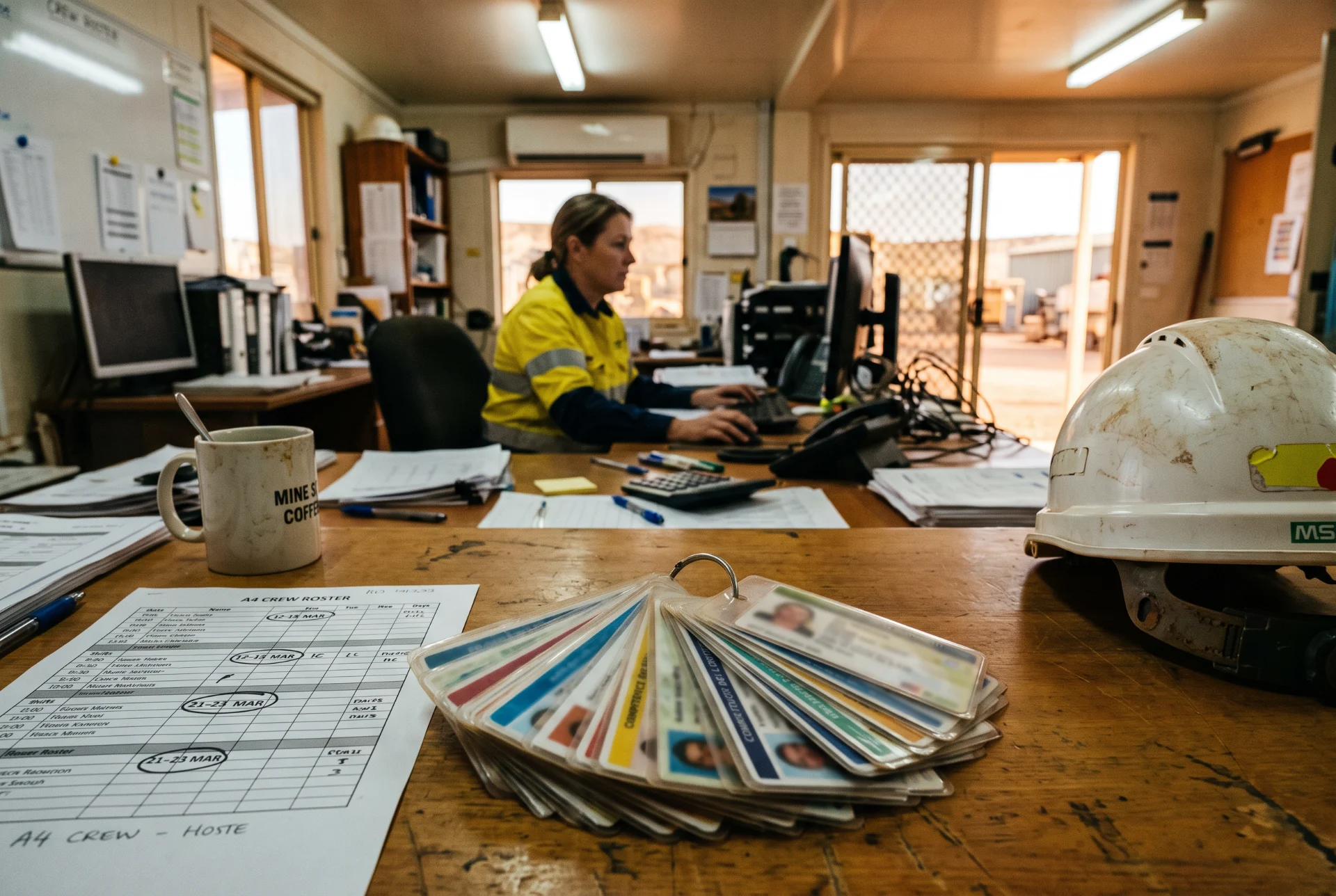
The question the hardware cannot answer
Strip away the technology and a gate answers one question: should this specific person be on this specific site right now?
That sounds simple until you list what actually feeds the answer. Employment status with an approved contractor. A completed site induction, and often a separate area induction. A current medical, sometimes with site-specific requirements around drug and alcohol testing. Verified competencies for the work they are doing that day. A valid client site access card or ID. Approval against a specific work order or project. A bed in camp if it is a residential site. A seat on a flight if it is FIFO. And whether any of those things has lapsed since the last time anyone checked.
Every one of those facts lives somewhere. That is not the issue. The issue is that they live everywhere. The inductions sit in the client's learning management system. The medicals sit with the occupational health provider, or in a spreadsheet in the HR drive, or in an inbox. The competencies sit in a training matrix maintained by a coordinator who is on leave. The mobilisation status sits in an email chain. The work order approval sits in the client's system, which the contractor cannot see.
When you buy hardware first, what you have really done is build a very expensive question machine with no authoritative source of answers. The turnstile asks, in effect, "is this person green or red?" and there is no single system anywhere in the arrangement that can respond with confidence. So the project team does what project teams do: they build a workaround. A spreadsheet that gets uploaded nightly. A manual override list at the gatehouse. A standing instruction that if someone is red but the supervisor vouches for them, wave them through and sort it out later.
At which point you have spent serious capital to recreate the clipboard, with extra steps.
Where the answer should live
The fix is not more hardware and it is not a bigger integration budget as a first move. The fix is a decision, and it is a governance decision before it is a technical one: which system is the source of truth for site access eligibility, and who owns keeping it right?
Notice that this is one decision with two parts, and the second part is where most organisations flinch. Naming a system is easy. Naming an owner means someone's team now carries accountability for data that used to be conveniently nobody's job. The training coordinator who maintained her own matrix has to give it up or feed the central record. The client has to expose induction status in a way contractors can consume. The contractor has to submit mobilisation data in a structured format rather than a PDF attached to an email titled "final list v3 FINAL."
None of that requires a single dollar of hardware. All of it is harder than buying hardware, which is exactly why hardware gets bought first.
A useful test for whether you are ready to automate a gate: can a human being, sitting at a desk with the systems you have today, answer "should Jane Smith be on site tomorrow?" in under two minutes, from one place, without ringing anyone? If the answer is no, a turnstile will not fix that. It will just deliver the wrong answer faster and with more confidence.
The failure modes are predictable
Watch enough of these projects and the same patterns repeat.
The dual-record drift. The access system gets its own copy of the workforce data, seeded from a one-off export. From day one it starts drifting from reality, because people join, leave, change roles and lose tickets continuously, and the "sync" is a person doing uploads when they remember. Within six months the access system is a confidently wrong mirror of the workforce, and the gatehouse keeps a paper exception list to compensate.
The green light of false comfort. Once a badge works, everyone assumes the checking has been done. But if the underlying data was wrong when it was loaded, the technology has now laundered a compliance gap into an apparent compliance pass. A worker with an expired ticket walking past a guard might get questioned. The same worker badging through a turnstile will not, because the machine said green and machines feel authoritative. The site is arguably worse off than it was with the guard.
The exception process becomes the process. Every access system needs an override for genuine urgency. But if the data feeding the system is unreliable, overrides stop being exceptions and become the standard path. Supervisors learn that the fastest way to get their crew on is the override form, and the system's real function becomes generating paperwork about how it was bypassed.
The blame boomerang. When someone is turned around at the gate and a shift is lost, the access system gets blamed, the vendor gets a hostile phone call, and the project loses sponsorship. But the system did its job. The mobilisation submission was late, or the medical booking slipped, or the induction record never came across. The gate is simply where upstream data failures become visible, expensive and personal. Shooting the messenger is traditional, but it does not fix the message.
Doing it in the right order
If the gate is a data problem, the project plan changes shape. The sequence that works looks something like this.
First, define eligibility in writing. Not in anyone's system, on a page. What are the actual conditions of entry for each category of person on this site? You will find disagreement immediately, between the client's contract requirements, the safety team's expectations and what the gatehouse actually enforces. That disagreement is the project. Resolve it now, cheaply, on paper, rather than later, expensively, in change requests.
Second, pick the source of truth for each fact and name an owner. Inductions might live with the client, medicals with the health provider, employment and mobilisation with the contractor. That is fine. Multiple sources are workable as long as each fact has exactly one, and someone accountable for its accuracy and timeliness.
Third, fix the feeds before the gate. Get mobilisation data flowing in a structured way. Get expiry dates into a system that can look forward, not just report backwards. Run the eligibility check as a report for a few months with the existing gatehouse process still in place. Every mismatch the report finds is a defect you get to fix quietly, instead of a worker turned around in front of their crew at 5:30am.
Only then buy the hardware. By that point the turnstile is the boring part of the project, which is exactly what it should be. It is a peripheral. It is the printer at the end of a payroll run. Nobody designs a payroll process around the printer.
The gate is a mirror
Here is the reframe worth taking into your next capital meeting: the gate does not create order, it reveals whether you have any. A site with clean, owned, current workforce data can put almost any access technology on the front of it and it will work. A site without that can install the most sophisticated biometric system on the market and it will faithfully automate the confusion.
So before anyone signs a purchase order for turnstiles, ask the two-minute question. Pick a name at random from next week's crew list and ask the room: should this person be on site, and which system says so? If the answer involves three tabs, a phone call and the phrase "well, it depends who you ask," you have found your project. It is just not the one in the brochure.